Slot discipline: quadrants, levels and burbles
Flying a slot safely is a discipline of level first, then proximity. Quadrants, the burble, and the level-slot-dock ladder are the tools that keep a group tight, and tight is what keeps closing speeds down.
The Freefly Project · 11 August 2026
Flying a slot well means getting on level in the right place before closing the distance. On an angle or head-down, the order is the same: fly to your assigned quadrant, get on level, then close. Flown in that order the group stays tight, and tight is what keeps closing speeds down.
Level first, then proximity
Getting on level means flying to the straight line through the group’s heads, its leading edge, before closing. The order is fixed: quadrant, then level, then close. On an angle, belly flyers sit above the leader’s line and slightly ahead, while back-flyers sit below and slightly behind with a lateral offset. Those offsets grow as the jump flattens and the burble grows, and everyone can fly more head-to-head as it steepens.
Closing is aimed ahead of the group, halving the remaining distance in controlled stages, and only ever as fast as you can think.
The burble, and why it matters
Every group trails a burble up and behind it on an angle, and flatter angles make it larger. The rule that follows is simple: never approach through that corridor. Get on level first and come in from the side. On any orientation, never let your legs pass the leader’s head.
In head-down group and big-way flying the shelf position exists partly to keep the legs out of the formation’s burble, and when presenting for the next flyer you reach an arm wide of the leg burble, hand in a fist, eyes back into the group.
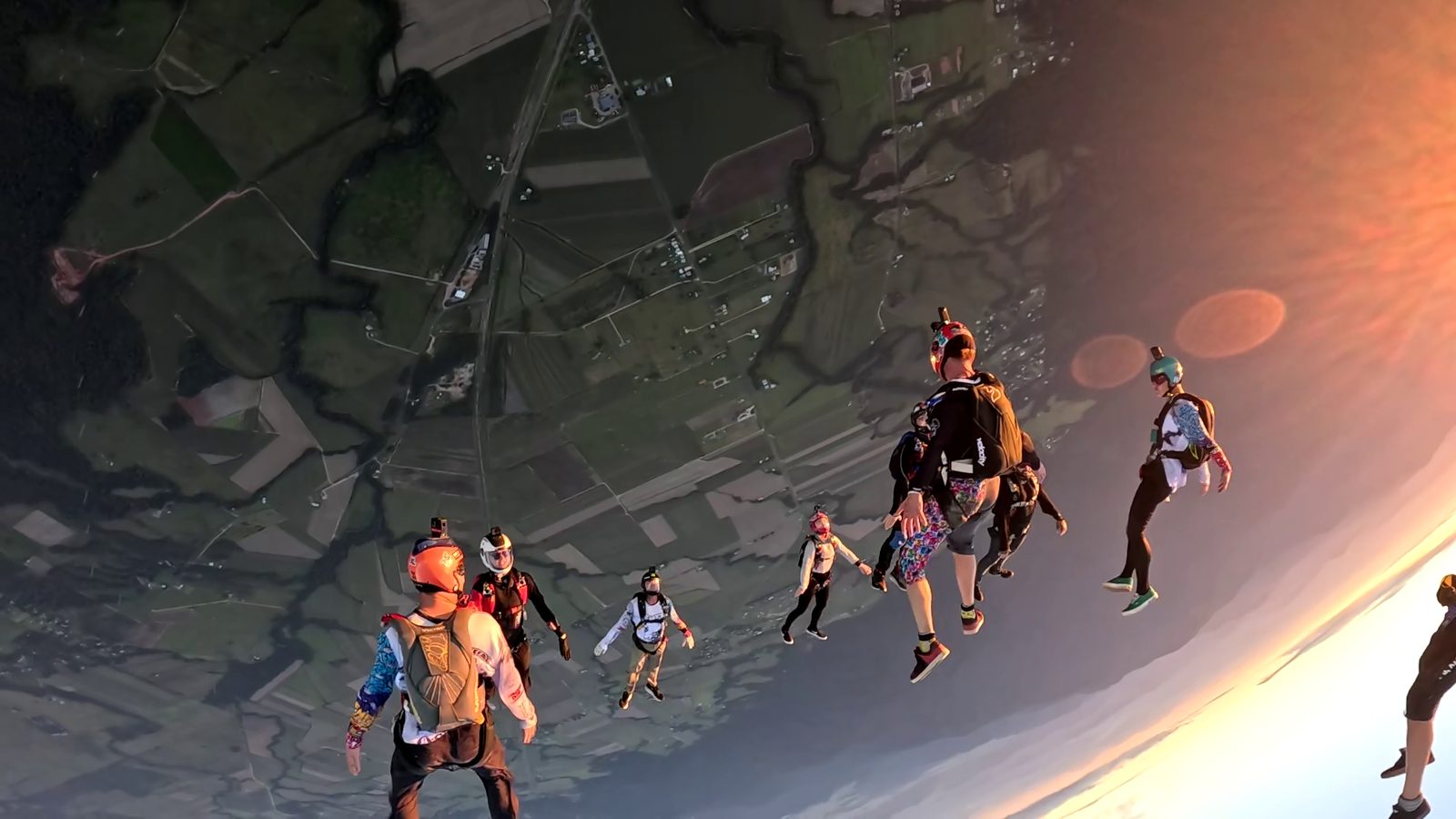
Levels and slots seen from above on a big-way angle. The belly flyers fly forward of the leader with the sight picture aligned down onto the back flyers’ heads, which is what keeps them out of the burbles. Look closely and the belly flyer in the second god slot is sitting slightly behind the slot, the kind of small levels error a debrief names to the whole group.
Levels, slots and the dock ladder
Docking has its own ladder: hold level for a beat, hold the slot for a beat, then initiate the dock. In head-down two-ways, crest docks and group jumps, that runs as roughly three seconds on level, three seconds in the slot, then the dock. The body flies to the grip, not the arm.
Reaching generates lift and drive away from the formation, so headings and reference points are held off the base and the horizon rather than off the reaching arm. Grip mechanics matter too: a sting is a thumb-down overgrip with the arm low and straight, where air pressure holds the hand on so the grip can stay light, and a dock is a thumbs-up undergrip with the arms wide.
Period coaching in the Australian Skydiver Magazine (ASM 68) put it plainly: approach and dock from slightly below, float up onto the grip with pressure, and do not dock unless you improve the formation.
Heading discipline and safe zones
Whenever displaced, keep the body pointed on the group’s heading and use a side-slide or a speed change to close. Never turn 180 degrees from the group’s heading or back toward jump run, because off-heading collisions carry the highest closing speeds. Closeness is the standard: the tighter a group is, the safer it is, because closing speeds and accidents build in the gaps that open when a group spreads.
Fly at docking distance even when you are not docking. The guide also names safe zones and no-fly zones around a group, and the leader briefs them.
Recovering in the slot
On any instability, add speed in the group’s direction along the jump’s angle. Do not ball up, and do not track away. Re-approach only when stable. If separation persists, hold the group’s heading and follow, stop the closure high, hold the distance, and break off on the group’s timing, because breaking off early and blind above a descending group is how followers meet deploying canopies.
In head-down, control fall rate without corking up into the group: ball up, recover clear of traffic, and rejoin only when stable and on level. Taking a knock without corking, per the Australian Skydiver Magazine (ASM 68), means tucking the chin, closing the legs and going faster.
Spreading the legs slows the flyer and pops them up out of level into diver traffic, so a flyer holds the base by closing up and driving down.
The takeaway
Fly the slot as level first, then close, and treat distance as the hazard it is. Quadrants place you, the burble tells you where not to go, and the dock ladder keeps the whole group tight and slow-closing.
Advisory, educational content. Fly slots only in briefed groups under a trained leader or coach, and comply with your federation and drop zone.
Suggest a change to this page open
Spotted an error, or know something this page should cover? Tell us. We read every suggestion, and work accepted changes into the site.